

What makes the molecule special
Semaglutide activates one receptor (GLP-1), Tirzepatide two (GIP + GLP-1), Retatrutide three (GIP + GLP-1 + glucagon) — the only triple agonist in advanced clinical development so far. The combination addresses all three central mechanisms of energy metabolism at once: reduced food intake, stronger insulin secretion, higher energy expenditure. Weight loss doesn’t just come from eating less — you’re also burning more.
Molecularly Retatrutide is a synthetic peptide of 39 amino acids with an attached fatty-acid chain for albumin binding — hence the roughly six-day half-life that makes weekly injection possible.
Mechanism
GLP-1 receptor — dampens appetite, slows gastric emptying, strengthens postprandial insulin secretion. Less “food noise”, earlier satiety, fewer calories.
GIP receptor — supports pancreatic insulin response and modulates adipocyte metabolism directly (GIPR sits on fat cells). Synergy with GLP-1.
Glucagon receptor — the wildcard. Historically problematic because glucagon raises blood sugar. In combination with GLP-1 and GIP that effect is overcompensated: blood sugar stays stable while energy expenditure measurably rises. Glucagon boosts hepatic fatty-acid oxidation and basal metabolic rate.
In animal models Retatrutide also reprograms white adipose tissue — less fat storage, more mitochondrial activity, less inflammation. The fat tissue doesn’t just shrink; it becomes functionally healthier.
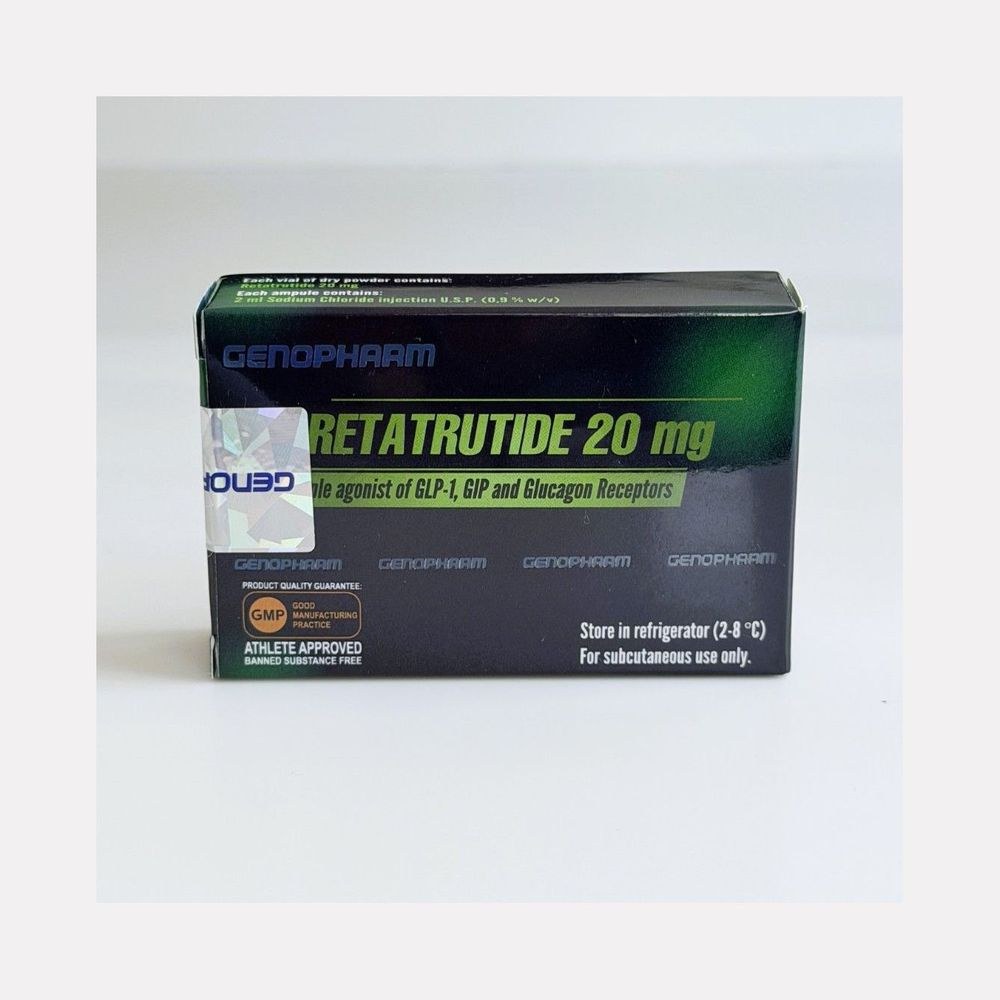
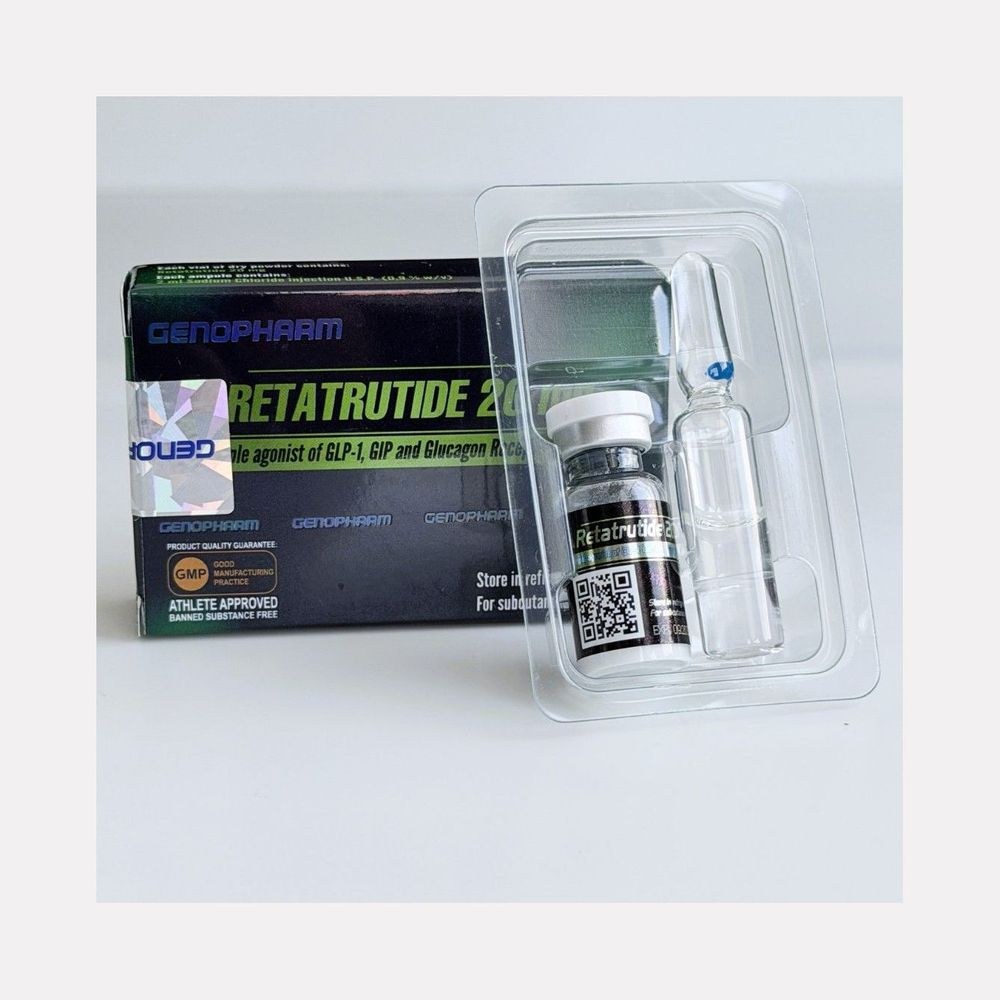
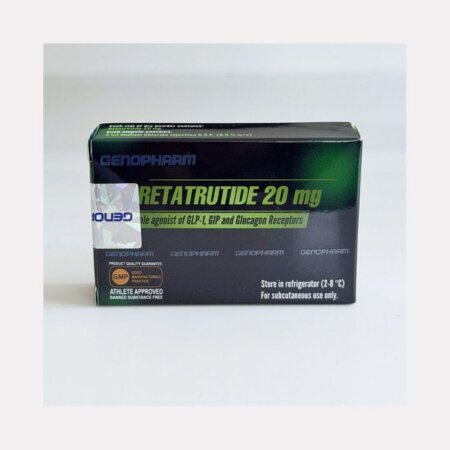
Genopharm 20 mg vial
20 mg of lyophilised peptide, GMP production, no additives. With a clean titration (0.5 → 2 → 4 → 8 mg over 16 weeks), one vial lasts about 8–10 weeks. At the 12 mg target weekly dose, the product is consumed in 8–10 days — for longer runs, plan on multiple vials.
TRIUMPH-1 data
Phase-3 trial with over 2,400 participants (overweight without diabetes), randomised to 4 / 8 / 12 mg Retatrutide vs. placebo. On 12 mg weekly: 28.3% weight loss after 80 weeks, 30.3% after 104 weeks. Placebo respectively 3.2% / 2.9%. Secondary endpoints — waist circumference, blood pressure, triglycerides, CRP — all moved in the right direction.
For comparison: semaglutide roughly 14%, tirzepatide 17–20%, bariatric sleeve gastrectomy 25–30%. Market approval is expected late 2027 or early 2028.
The grey-market reality
An analysis of 13,589 Reddit posts by “Retatrutide” users shows a side-effect profile that deviates significantly from the clinical picture: increased appetite instead of appetite suppression, fatigue, elevated heart rate, insomnia, few GI complaints. The most plausible explanation: many products sold as “Retatrutide” on the grey market don’t contain what’s on the label. For a peptide with no finished-drug reference on the market, third-party analysis of your own batch is baseline hygiene.
Safety and legal status
Clinical side-effect profile in the range of other incretin agonists: nausea (about 40% at 12 mg), vomiting and diarrhoea (15–25% each), constipation, dyspepsia, injection-site reactions. Meta-analysis: RR 1.87 vs. placebo. Special events — hypersensitivity reactions and pancreatitis.
Not approved as a medicine in the US, EU or UK. Distribution as a “research chemical” is a legal fig leaf that doesn’t hold up when sale is aimed at consumption — under Western drug-control legislation, purchase, possession and import can carry criminal consequences. WADA 2026: not named on the Prohibited List but falls under category S0 (non-approved substances). For tested athletes it’s a guaranteed positive finding at any time.
Instructions
Reconstituting the 20 mg vial
Recommended dilutions for the titration steps:
- 2 ml water → 10 mg/ml → 0.05 ml = 0.5 mg (introduction)
- 4 ml water → 5 mg/ml → 0.4 / 0.8 / 1.6 / 2.4 ml for 2 / 4 / 8 / 12 mg
Spray water slowly at the vial wall, then roll for 30 seconds — do not shake. The solution has to be clear, no cloudiness, no particles.
Titration schedule
| Phase | Dose | Duration |
|---|---|---|
| Introduction | 0.5 mg weekly | 4 weeks |
| Titration step 1 | 2 mg weekly | 4 weeks |
| Titration step 2 | 4 mg weekly | 4 weeks |
| Titration step 3 | 8 mg weekly | 4 weeks |
| Target dose | 12 mg weekly | Continuous |
The long titration isn’t a nice-to-have: the combined action across three incretin receptors isn’t tolerable at fast dose escalation. Starting the introduction at 2 mg instead of 0.5 mg risks severe nausea, vomiting and dehydration in the first week.
Injection technique
Subcutaneous into the abdomen, thigh or upper arm. Insulin syringe 30G × 8 mm for volumes up to 1 ml; at 12 mg / 2.4 ml a longer needle is more practical. Keep the weekday constant. Anyone splitting the weekly dose into two injections often reports less nausea — pharmacokinetically neutral.
Holding on to muscle
A share of the weight loss comes off lean body mass. For trained users:
- Resistance training 3–5× per week with progressive overload
- Protein 2.2 g/kg fat-free mass
- Moderate deficit of 300–500 kcal — no extreme hunger
- Creatine supplementation
Storage
Before reconstitution: fridge 2–8 °C, protected from light. After reconstitution: 2–8 °C, use within 4 weeks. Do not freeze; faster activity loss at room temperature.
When to stop immediately
- Upper-abdominal pain radiating to the back with vomiting — pancreatitis suspicion
- Visible lumps on the neck — thyroid C-cell workup
- Severe allergic reactions
- Persistently elevated liver values
- Massive muscle mass losses
After stopping: taper slowly. Rebound with clear weight regain is documented for GLP-1-class compounds — structured calorie management for 2–3 months after the end is recommended.




Reviews
There are no reviews yet