
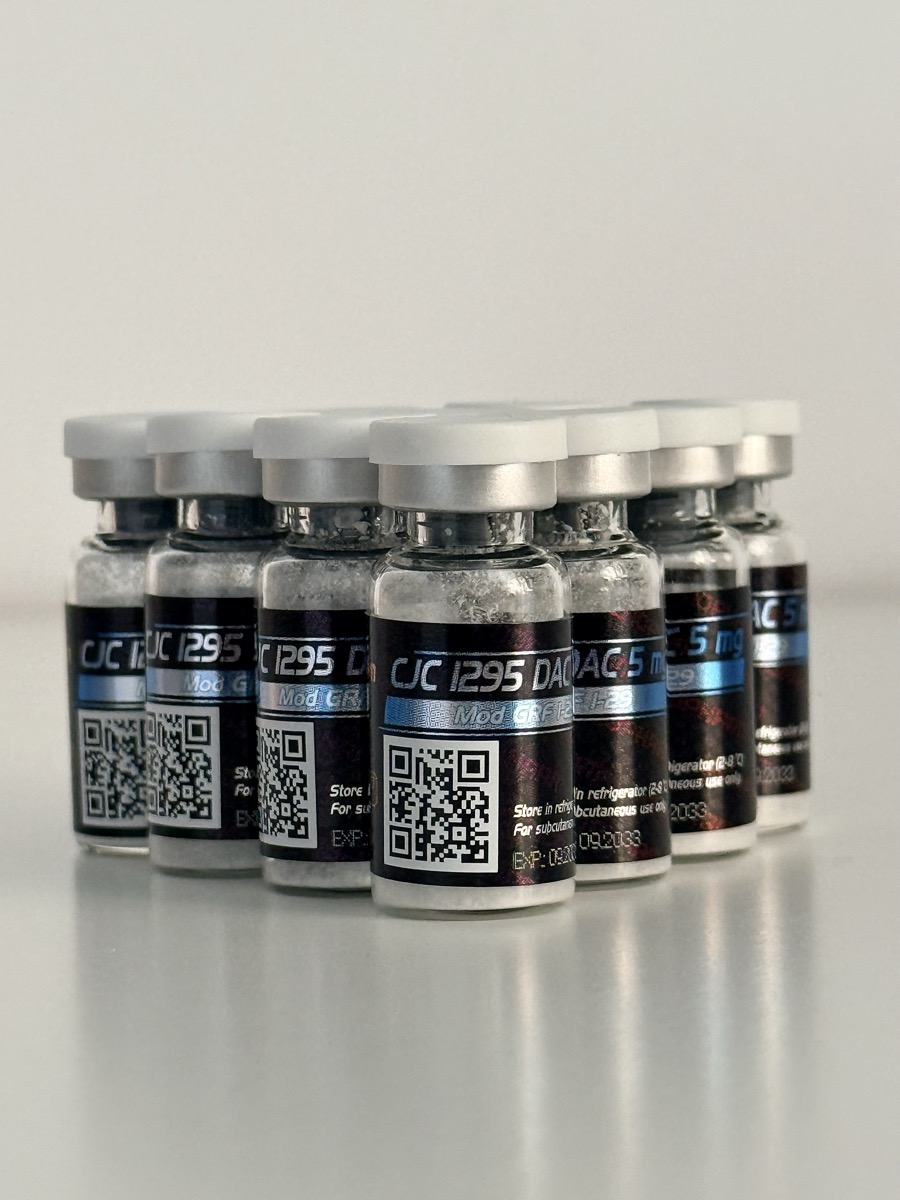

What DAC actually means
CJC-1295 is a synthetic analogue of growth-hormone-releasing hormone (GHRH), developed in the early 2000s by the Canadian firm ConjuChem Biotechnologies. The name comes from the developer and the molecular mass. The peptide exists in two variants, pharmacokinetically different enough that the FDA and WADA treat them as separate substances.
The difference sits in one chemical add-on: the Drug Affinity Complex (DAC), a lysine-maleimidopropionic-acid linker that binds covalently to blood albumin. Albumin is the most abundant plasma protein, with a half-life of about 20 days. Through the DAC anchor, CJC-1295 becomes a kind of albumin passenger — protected from enzymatic degradation, released continuously, with a half-life of 6 to 8 days in humans. The no-DAC version (Mod GRF 1-29) sits at around 30 minutes — a 300× shorter clock.
Anyone treating the two variants as interchangeable produces either a useless application or an oversized GH stimulation nobody needs.
How it works in the body
The mechanism is easiest to see through the natural regulation of growth hormone. In the hypothalamus, GHRH is produced in pulses and shipped through the hypophyseal portal system to the pituitary. GHRH binds the GHRH receptors on the somatotroph cells and triggers release of stored GH plus transcription of the GH gene. Endogenous GHRH gets broken down within 20–30 minutes and the release ends.
CJC-1295 DAC imitates that GHRH, but with one crucial modification: the albumin-bound form isn’t broken down within minutes — it releases continuously and slowly. The result is not a pulsatile GH release but a gentle, sustained elevation of the GH baseline across days.
Physiologically that’s a compromise. Natural GH secretion goes out in pulses with high peaks in the early deep-sleep phases. A continuous elevation produces a measurable rise in IGF-1 but bypasses the pulsatile patterns. Practical takeaway: users expect an elevated IGF-1 baseline that, when triggered by training, drives stronger muscle-protein synthesis, collagen formation and fat mobilisation.
What Genopharm delivers
Genopharm has positioned itself in the peptide segment as a supplier with consistent purity. The 5 mg vial of CJC-1295 DAC contains pure peptide as lyophilised powder, GMP-produced. At typical community doses of 1–2 mg per week, one vial covers 3–5 weeks. A 12-week cycle needs 3–4 vials.
Where users reach for it
Three profiles dominate in reports:
- Recovery and regeneration — the most consistently reported effect: milder DOMS after heavy training, deeper sleep, noticeably better training capacity after a few weeks.
- Body composition — GH and IGF-1 support fat mobilisation (visceral in particular) and help hold on to muscle in a deficit. The effects are subtler than under anabolic steroids and take 6–12 weeks.
- Anti-ageing and longevity — this community markets CJC-1295 DAC as a building block for “healthy ageing”. The data on that use is minimal; marketing rests on the general observation that GH drops with age.
Because of the slow onset, you don’t feel a sharp classical GHRP peak. The IGF-1 elevation builds across 1–2 weeks and then stays stable.
CJC-1295 DAC plus Ipamorelin
In the anti-ageing and peptide crowd the combination with Ipamorelin has become basically default. The two peptides activate different receptors — the GHRH receptor (CJC) and the ghrelin receptor (Ipa) — and act synergistically. CJC-1295 DAC lifts the GH baseline, Ipamorelin delivers extra pulsatile peaks at each injection. The combined GH release is markedly stronger than the two products added up separately.
Controlled clinical trials on this stack don’t exist; the practice rests on pharmacological plausibility and empirical experience.
Legal status and WADA
CJC-1295 is not approved as a medicine in the US, EU or UK. Under Western controlled-substances legislation, distribution is a criminal offence; import through customs for personal use falls into a legal grey zone that varies by country. Unlike some peptides that live in a broader grey area, the legal status of CJC-1295 is comparatively clear-cut.
WADA Prohibited List 2026: CJC-1295 sits in category S2 (peptide hormones, growth factors), banned at all times. Detection via LC-MS/MS is possible; the albumin-bound form’s long circulation time means it stays detectable proportionally longer.
Instructions
Reconstitution
The 5 mg vial is reconstituted with bacteriostatic water. Sensible dilutions:
- 2 ml water → 2.5 mg/ml → 0.4 ml = 1 mg
- 2.5 ml water → 2 mg/ml → 0.5 ml = 1 mg
- 5 ml water → 1 mg/ml → 1 ml = 1 mg
Spray water slowly at the vial wall, not directly onto the dry powder. Roll the vial for 30 seconds between your palms — never shake. After reconstitution the solution must be clear.
Dosing
| Parameter | Common practice | Note |
|---|---|---|
| Weekly dose | 1–2 mg | Split across 1–2 injections |
| Frequency | 1× per week, or 2× 0.5–1 mg | Half-life allows wide intervals |
| Cycle length | 8–12 weeks | 4–6 week break between cycles |
| Stacked with Ipamorelin | 100–300 µg Ipa 1–2× daily | Separate injections recommended |
The only controlled human trial on CJC-1295 DAC (Teichman et al., 2006) used weight-based dosing of 30–120 µg/kg per week — at 90 kg that would be 2.7–10.8 mg per week. What circulates in forums (1–2 mg) is much more conservative, which is plausible from a safety standpoint but means practice doses haven’t been systematically validated.
Injection technique and timing
Subcutaneous injection into the abdominal wall or the outer thigh. Insulin syringe 30G × 8 mm is enough for typical volumes (0.4–1 ml). Lift a skin fold, inject at 45° or 90°.
Timing matters less with the DAC version than with no-DAC, because the peptide is circulating for days anyway. Some inject in the morning, some in the evening — consistency across the weeks matters more than the time of day. On a weekly schedule, the same weekday helps (always on Sundays, say).
Storage
Before reconstitution: fridge at 2–8 °C, kept away from light.
After reconstitution: fridge at 2–8 °C. Use within 2–4 weeks. Do not freeze — peptide folding gets wrecked by freeze-thaw cycles. At a 2 mg weekly dose, a 5 mg vial covers about 2.5 weeks, which fits neatly inside that window.
What to check when it isn’t working
If nothing noticeable shows up after 4–6 weeks (sleep, recovery, training capacity), the most common causes are:
- Bad storage (freeze-thaw cycles, temperature swings)
- Under-dosed (below 1 mg/week)
- Insulin/blood-sugar spike close to the injection (blunts GH release)
- Chronic sleep debt — the endogenous amplifier is missing
- Product quality — purity under 95% can meaningfully cut the effect




Reviews
There are no reviews yet