

The compound and where it comes from
Thymosin Alpha-1 is naturally produced in the thymus — the gland behind the sternum that in childhood and adolescence drives T-lymphocyte maturation. In adulthood the thymus tissue shrinks progressively, a process called “thymic involution”, tied directly to the age-related weakening of the immune system.
TA-1 was first isolated and synthetically reconstructed in 1977 by the American immunologist Allan Goldstein, from thymus extracts. The amino-acid sequence of the synthetic version is identical to the endogenous peptide — a pharmacological advantage that sets TA-1 apart from purely synthetic research peptides with chemically modified sequences.
The brand name Zadaxin belongs to SciClone Pharmaceuticals. Approved indications in countries with a regular license: chronic hepatitis B and C, selected primary immunodeficiencies, and in some countries also adjuvant cancer therapy and a booster effect for vaccines. Over 45 human trials, data from more than 11,000 subjects — an evidence base most peptides in this category simply don’t have.
How the peptide works
The term “immunomodulator” applies to TA-1 in the literal sense. The peptide isn’t a pure stimulator driving the immune response up, nor a suppressor. It behaves like a thermostat: an underperforming immune system gets nudged up, an overshooting one gets damped — the answer tends toward homeostasis, not runaway activity.
At the molecular level TA-1 hits several points:
- Promotes T-cell maturation, particularly CD4+ helper and CD8+ cytotoxic T cells
- Activates dendritic cells and natural killer (NK) cells
- Modulates Toll-like receptor signalling (TLR2, TLR3, TLR4, TLR7, TLR9)
- Increases interferon-γ production
- Balances cytokine levels — the Th1/Th2 balance shifts toward intact immune response
For athletes one aspect matters specifically: TA-1 can regulate the immune response to training-induced tissue damage and blunt the overshooting inflammation phase after heavy sessions, without shutting down the baseline inflammation that repair itself needs.
Typical use profiles
Field reports converge on a handful of use goals:
- Fewer infections during intense training blocks and competition prep
- Faster return to training after viral infections
- Modulation of chronic inflammatory states that hold recovery back
- Support for post-viral fatigue syndromes (Long COVID, ME/CFS-like states)
- Potential support for muscle repair through better immune regulation
Unlike steroids, TA-1 isn’t targeted at an anabolic effect. Muscle building isn’t the goal here. It’s about the foundation muscle building actually runs on: a functioning immune system, controlled inflammation, adequate recovery.
What Genopharm offers
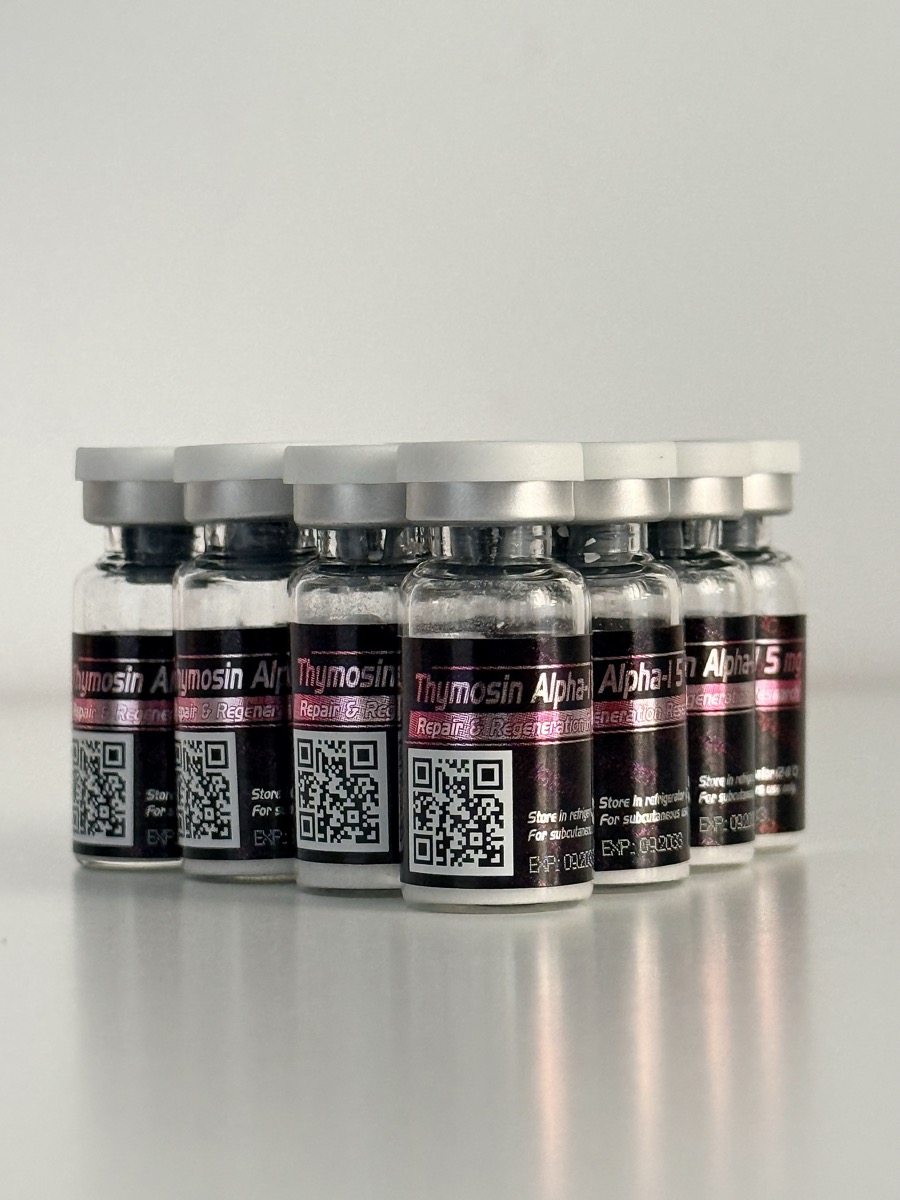
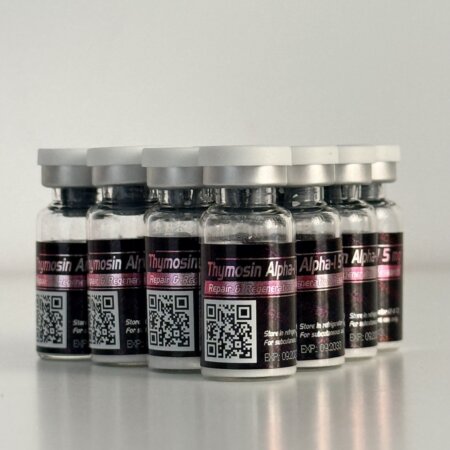
Genopharm ships TA-1 as lyophilised powder, 5 mg per vial. At the standard dose of 1.6 mg twice weekly, one vial covers about 3 weeks — for standard 8-to-12-week cycles you need 3–4 vials for a full run.
Safety and legal status
Compared to many other peptides, TA-1 has a favourable safety profile. A Cochrane review on chronic hepatitis B found: across five trials, 54 of 534 people (10.1%) on TA-1 had a serious adverse event, versus 70 of 522 (13.4%) in the control group. A slight edge for the peptide.
Common side effects are mild and short-lived: fatigue, headaches, injection-site reactions, occasionally mild dizziness.
Two groups need to be careful. First, people with active autoimmune disease — immunomodulation can push overshooting autoimmune reactions in the wrong direction. Second, people on established pharmacological immunosuppression (transplant recipients, oncology chemotherapy).
Legal picture: in the US, EU and UK, TA-1 is not approved as a medicine (unlike in Italy or China). Distribution as a research chemical, legal grey zone. Importing Zadaxin from Italy through an international pharmacy with a Western prescription is theoretically possible, in practice rarely workable.
Worth flagging on the WADA status: TA-1 is not on the Prohibited List. One of the few peptides that’s basically allowed for tested athletes — a distinctive feature that makes the peptide interesting for tested athletes in federated sport. Federation-specific rules should still be checked.
Instructions
Reconstitution
The 5 mg vial is reconstituted with bacteriostatic water. Sensible dilutions:
- 2.5 ml water → 2 mg/ml → 0.8 ml = 1.6 mg (one standard dose)
- 5 ml water → 1 mg/ml → 1.6 ml = 1.6 mg
Spray water slowly at the vial wall, then roll for 30 seconds. Do not shake.
Dosing
For TA-1 the dose is remarkably consistent across different indications:
| Parameter | Standard | Note |
|---|---|---|
| Dose | 1.6 mg | Flat dose, not weight-based |
| Frequency | 2× per week | e.g. Monday and Thursday |
| Cycle duration | 8–12 weeks | For general immune support |
| Clinical use | 6–12 months | For chronic hepatitis therapy |
| Route | Subcutaneous | Abdomen or thigh |
The 1.6 mg dose comes from the original registration trials and is used across essentially all indications unchanged — regardless of body weight or baseline immune function. Reason: TA-1 acts through receptor binding, not through a maintained serum concentration. 1.6 mg is enough to saturate the relevant receptors; higher doses don’t add benefit.
Plasma half-life is only around 2 hours. That looks short, but the effect isn’t built on a sustained serum concentration — it comes from repeated pulses triggering immunological signalling pathways. Two injections per week are enough for a lasting effect.
Injection technique
Subcutaneous into the abdomen or thigh. Insulin syringe 30G × 8 mm, lift a skin fold, insert at 45° or 90°. Rotate sites.
On injection days it helps to inject at the same time of day (e.g. mornings before breakfast, or evenings before sleep) — that makes consistency across the whole cycle easier to hold.
Storage
Before reconstitution: fridge at 2–8 °C, kept away from light.
After reconstitution: fridge at 2–8 °C, use within 2–7 days. The most pharmacologically important point is temperature: repeated freeze-thaw cycles cause protein aggregation and measurable activity loss — the single most common reason a legitimate batch underperforms in use. For a vial that only stays in play 3 weeks, standard fridge storage without freeze-thaw cycles is fine.



Reviews
There are no reviews yet