
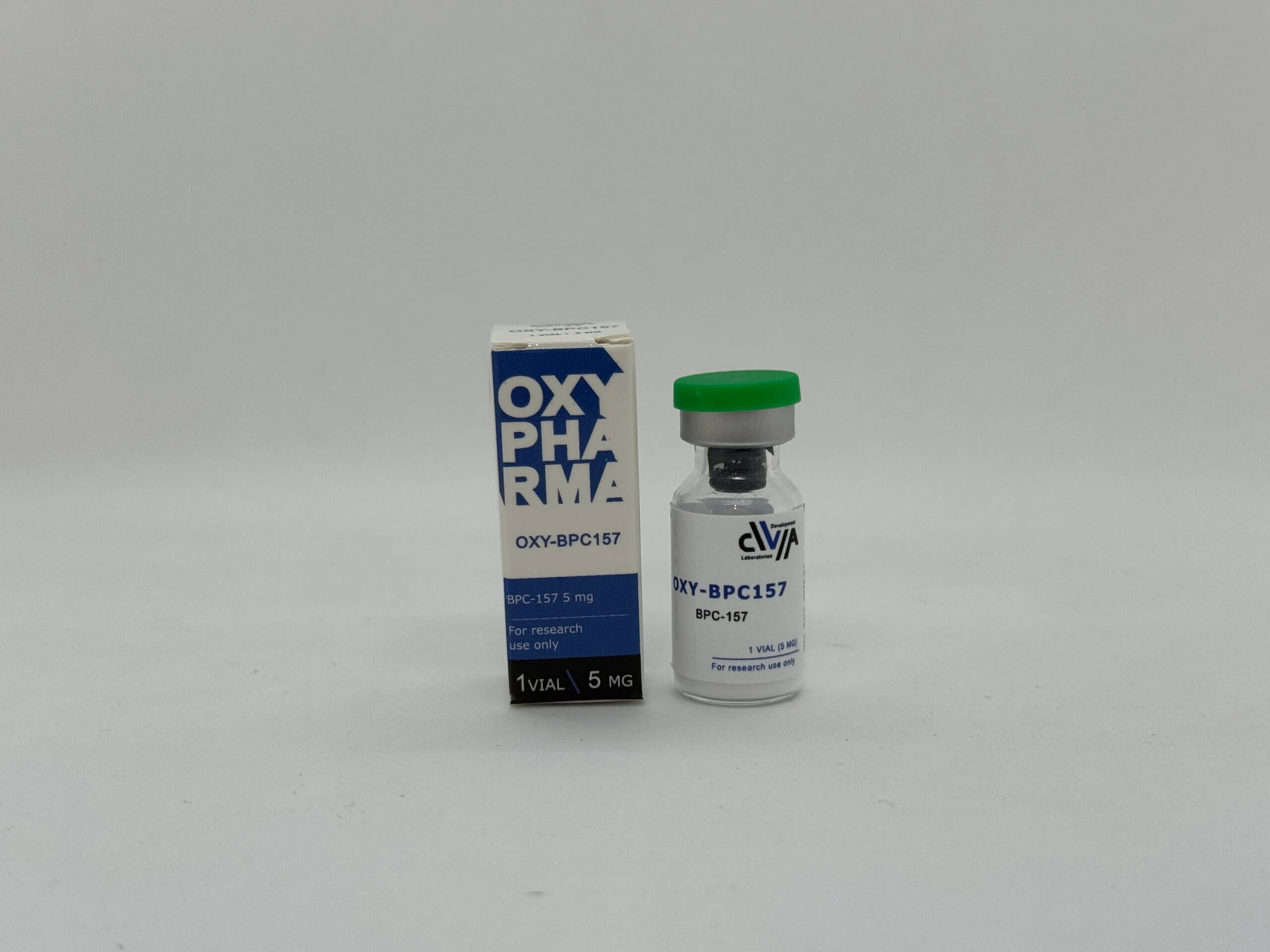
What sits inside the vial
Body Protection Compound 157 — BPC-157 for short — is a chain of 15 amino acids. The sequence was first isolated in 1993 by Predrag Sikirić’s group at the University of Zagreb, and most of the basic research still in print today comes out of that same lab. Chemically it isn’t a classic receptor ligand with one target molecule — it is a peptide with what gets called pleiotropic activity: several signalling pathways active in parallel, no single dominant “master receptor”.
What makes the peptide unusual is its stability. Peptides normally get shredded in the digestive tract inside minutes. BPC-157 holds up under proteolysis a fair bit longer, which puts it in a structurally different class from the likes of GLP-1 analogues or standard SARMs.
What it does in the body
Two mechanisms dominate the discussion.
The first is angiogenesis — new capillary formation in the damaged area. Zhang et al., writing in Cell Communication and Signaling in 2026, mapped out a concrete molecular pathway through which BPC-157 kicks off new-vessel growth. An intriguing detail: the third proline residue in the molecule is essential. Swap it out experimentally for a different amino acid and the peptide loses its angiogenic effect almost entirely. The sequence isn’t an accident.
The second is collagen synthesis. Tendons, ligaments, fascia — all of them need functional collagen to heal. BPC-157 stimulates fibroblast activity and collagen expression, which in animal models with a severed Achilles produced measurably faster tendon repair.
At the GI level there is a third effect: erosive lesions in the gastric mucosa — the kind that build up under sustained NSAID load — repair more quickly in rats. That is the one plausible pharmacological application with a reasonably consistent data trail.
Where users actually reach for it
Field reports converge on a handful of patterns:
- Chronic tendinopathies at the elbow (tennis, golfer’s), the patellar tendon, the Achilles
- Muscle-fibre tears with a long rehab history behind them
- Post-op recovery after orthopaedic procedures
- Reflux, functional dyspepsia, exercise-related gastritis
Those reports are subjective, uncontrolled and rarely imaging-validated. What they show is a pattern — not proof. Between “it worked for me” and “it objectively worked” sit several rungs that a controlled trial has to fill in. For what it’s worth, BPC-157 remains an experimental peptide, not an approved therapy.
What OxyPharma delivers in the vial
OxyPharma is one of the peptide suppliers with reasonably consistent batch reliability in community circles. The 5 mg vial carries pure lyophilised peptide, no additives. A typical protocol of 250 µg twice daily works through one 5 mg vial over roughly 10 days — proportionally longer at lower doses. If a protocol calls for a bigger vial size, OxyPharma also lists a 10 mg option, which is useful for extended stacks with TB-500.
What to know before you buy
The FDA has BPC-157 on its “Category 2” list — substances excluded from compounding on the grounds of insufficient safety data. Three case reports on injectable BPC-157 are logged in the FAERS database through the end of 2025: injection-site redness and swelling, shortness of breath, hyperpigmentation. A published case report also describes a 40-year-old woman who used BPC-157 and TB-500 in parallel for “joint support” and developed diffuse hyperpigmentation.
WADA Prohibited List 2026: BPC-157 sits in category S0 (non-approved substances). For a tested athlete that’s a guaranteed positive finding — at any time.
Instructions
Reconstitution
The vial holds 5 mg of lyophilised powder. Before first use, reconstitute with bacteriostatic water. Common dilutions:
- 2 ml water → 2.5 mg/ml → 0.1 ml (10 insulin units) = 250 µg
- 2.5 ml water → 2 mg/ml → 0.125 ml (12.5 insulin units) = 250 µg
- 5 ml water → 1 mg/ml → 0.25 ml (25 insulin units) = 250 µg
Spray the water slowly against the inside wall of the vial — not straight onto the powder. Roll the vial for 30 seconds between the palms afterwards. Do not shake; shaking can wreck the peptide folding. Wait until the solution turns clear.
Community dosing in practice
| Use case | Single dose | Frequency | Cycle length |
|---|---|---|---|
| Acute tendon/muscle injury | 250–500 µg | 2× daily | 4–6 weeks |
| Chronic tendinopathy | 250 µg | 1–2× daily | 6–10 weeks |
| GI support | 250 µg | 2–3× daily | 4–8 weeks |
The rat-model doses of 10 µg/kg that get quoted in forums translate allometrically to roughly 1.6 µg/kg in humans — which would be around 110 µg for a 68 kg user. What the community actually uses sits comfortably above that number, which subjectively “feels stronger” but has no scientific grounding.
Injection technique
Subcutaneous injection into the abdominal wall or the outer thigh is the standard. Insulin syringe 30G × 8 mm, lift a skin fold, insert the needle at 45° or 90°, push the plunger slowly. Rotate sites to avoid lumps.
Some users inject as close as possible to the injured tissue, in the belief that there is a local effect. For a peptide that circulates systemically, needle placement’s real influence is doubtful — the abdominal wall stays easier and safer.
Storage
Before reconstitution: fridge at 2–8 °C, kept away from light. Unopened, stable until the printed expiry date.
After reconstitution: fridge at 2–8 °C. Use within 3–4 weeks. Avoid freeze-thaw — every freeze-thaw cycle knocks activity down measurably. Loss of activity from poor storage is the single most common reason a legitimate batch “does nothing” in an end user’s hands.
What NOT to do
- Shake the vial — the folding takes a hit
- Spray water straight onto the peptide — local denaturation
- Freeze already-reconstituted solution — activity loss
- Use it without collagen substrate — no vitamin C, no glycine, no proline means the tissue has no building material to work with
- Mix two peptides in one syringe unless sterility is guaranteed



Reviews
There are no reviews yet