
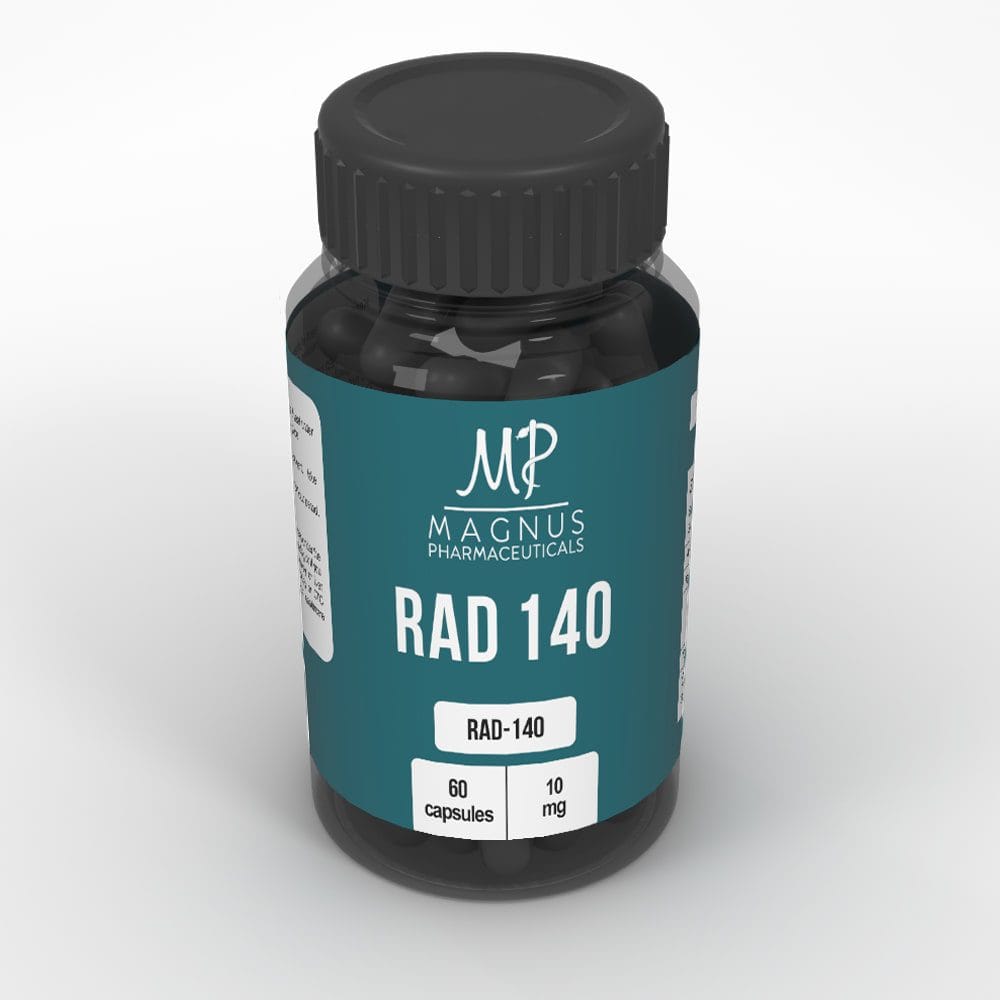
What RAD-140 is chemically
RAD-140 is a SARM originally developed by Radius Health — first for the treatment of AR-positive, ER-negative, HER2-negative metastatic breast cancer. “Non-steroidal” here means the molecule is not built on a steroid backbone like testosterone or DHT; the structure is synthetic, yet it still targets the androgen receptor (AR).
The INN of the compound is vosilasarm — better known in forums as Testolone. A quick side note: a SARM called “RAD141” does not exist pharmacologically. Anyone typing that is almost always after RAD-140. The muddle comes from typos and the phonetic likeness to RAD-150 (the ester form).
Approval as a medicine never came. The University of Michigan oncology trial studied 50, 100 and 150 mg daily in metastatic breast cancer patients — and landed on 100 mg per day as the maximum tolerated dose. Development programmes for sarcopenia, osteoporosis and tumour cachexia were quietly discontinued. What remained is the peptide and SARM market, where RAD-140 now circulates in capsules and tablets.
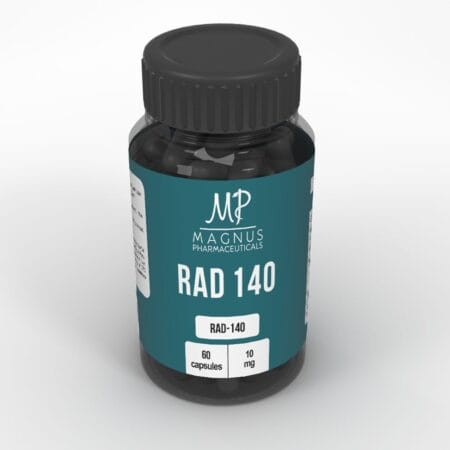
The 60 tablets × 10 mg format
This pack delivers 600 mg of active substance in total. At the usual community doses of 10–20 mg daily, one pack covers 30–60 days — one or two 8-week cycles, depending on how aggressive the dosing gets.
Tablets have a practical edge over capsules or liquid suspension: purity and active-ingredient content tend to be more consistent than in self-filled capsules from the many UGL suppliers around. The 10 mg tablets are usually scored for halving, which opens up a 5 mg dose — handy for first-timers or for the taper phase at the end of a cycle.
How RAD-140 works in the body
SARM selectivity is the operative term. Testosterone and DHT bind the AR with high affinity and switch it on across every AR-expressing tissue — muscle, bone, prostate, sebaceous glands, hair follicles. A non-selective agonist therefore produces an all-over effect profile, with the familiar androgenic collateral damage baked in.
RAD-140 also binds the AR, but with tissue-specific action. Molecular-docking studies show van-der-Waals contacts with amino acids Asn705, Gln711 and Arg752, plus a hydrogen bond to Thr877. In muscle cells, that activates AR-mediated transcription and feeds protein synthesis. In the prostate and breast, RAD-140 behaves more antagonistically — the receptor gets occupied but is not driven into the activating conformation.
This split between anabolic and androgenic effects is the central SARM marketing argument. In animal models the picture holds up neatly. In humans the selectivity is less sharp. RAD-140 suppresses endogenous testosterone production measurably — somewhat milder than a classical anabolic steroid, but measurably still.
Pharmacokinetics: elimination half-life 45 to 60 hours, high oral bioavailability. Peak serum levels show up within a few hours of the oral dose; steady state follows after 7–10 days on once-daily dosing.
What forums report
Field reports converge on a short list of recurring points:
- Clear increases in lean muscle mass (user reports: 3–8 kg over 8 weeks)
- Strength gains on compound lifts, sometimes in double-digit percentages inside four weeks
- Better muscle definition and hardness, less water than under aromatising steroids
- Quicker recovery between sessions
- No oestradiol side effects — no water, no gyno — because RAD-140 does not aromatise
One user described 15 pounds of body-weight gain after eight weeks at 15 mg daily, without really noticing the strength change — the gain only showed up on the scale. Reports like that are subjective and uncontrolled, mind you, but they do describe the typical pattern.
Controlled trials in healthy trained users, however, do not exist. All published human data come from the oncology trial in cancer patients at 50–150 mg daily — five to fifteen times higher than the 10–30 mg usually run in the bodybuilding context.
Documented side effects from the literature
SARM marketing tends to sell RAD-140 as “safe testosterone”. The case reports in the literature tell a rather different story.
Cardiovascular. A 22-year-old weightlifter was admitted with severe heart failure (NYHA III) after running six months of back-to-back eight-week cycles of RAD-140 without a break. Echo: dilated left ventricle with an ejection fraction of 15%. Cardiac MRI: subepicardial and mid-wall fibrosis. Nine months off RAD-140 later, cardiac function had only partially recovered — the damage was not fully reversible.
Thrombosis. A 48-year-old man developed arterial thrombosis with splenic and renal infarctions after three weeks of self-administered RAD-140. Genetic tests for Factor V Leiden and Protein C/S deficiency came back negative.
Liver. A 43-year-old man developed severe cholestatic liver injury, with total bilirubin at 708 µmol/L (normal < 20). Biopsy: drug-induced liver injury.
Rare cases — but real, and documented. Anyone running RAD-140 should keep an eye on liver values, lipids, haematocrit and blood pressure at the very minimum.
Legal status and WADA
RAD-140 is not approved as a medicine in the US, EU or UK. Under US federal law it is not currently a scheduled controlled substance, though the FDA has issued warnings against SARM-containing products; several US states have moved to schedule SARMs specifically. In the UK, RAD-140 falls under the Psychoactive Substances Act — possession is not criminalised, but supply is.
In organised sport, RAD-140 sits on the WADA Prohibited List in category S1.2 (Other Anabolic Agents). Banned at all times. The International Testing Agency recently suspended an Uzbek sambo athlete for a multi-SARM finding (ostarine, ligandrol, RAD-140) — the three were classed as non-specified prohibited substances, the harshest sanction category.
Instructions
Timing and bioavailability
RAD-140 is taken orally, usually washed down with a glass of water. Oral bioavailability is high — which is what sets RAD-140 apart from many other SARMs that need to be injected. Fasted or with food — the difference is minimal. What matters more is consistency: same time, same conditions across the whole cycle.
Some users split the daily dose into two portions (morning/evening), which brings no real pharmacokinetic benefit — the 45-to-60-hour half-life already delivers stable blood levels on once-daily dosing.
Dosing schedules
| Experience level | Daily dose | Cycle length |
|---|---|---|
| First cycle | 10 mg | 6–8 weeks |
| Intermediate | 15–20 mg | 8–10 weeks |
| Experienced, under bloodwork | 20–30 mg | 8–12 weeks |
At 10 mg per day (one tablet) the 60-pack covers exactly 60 days — just under 8.5 weeks. At 20 mg (two tablets) the same pack covers a 30-day cycle. The 60-pack is therefore well suited to a single first-time cycle, or half of an intermediate one.
PCT after the cycle
RAD-140 suppresses the HPG axis measurably. Post-cycle, total testosterone typically drops to 200–400 ng/dl and both LH and FSH sit suppressed. A PCT is therefore sensible, even if the suppression is milder than under an equivalently-dosed anabolic steroid.
Community standard: a SERM across 4 weeks after cycle end. Tamoxifen 20 mg daily, or clomiphene 25 mg daily. Without PCT, the axis takes noticeably longer to recover — and in individual cases it stays incomplete.
Bloods during and after the cycle
Around week 3–4, run a panel: ALT, AST, GGT, total bilirubin, creatinine, haematocrit, total and free testosterone, LH, FSH, LDL, HDL. If ALT or AST cross 3× the upper limit — stop the cycle. If bilirubin stays elevated — see a doctor; no continuation.
After the PCT, another panel to check axis recovery. If levels stay low (testosterone below 300 ng/dl after 8 weeks of PCT) — endocrinological workup.
Storage
Tablets at room temperature, dry, away from light. Keep blisters sealed until the dose is taken — active-ingredient stability depends on moisture protection. Fridge storage is not required.
And keep an eye on the expiry date printed on the pack. After expiry the efficacy drops; toxicity from breakdown products has not been documented in a SARM study so far, but neither has it been ruled out.
What NOT to do
- No repeat cycles without a PCT in between
- No stacking with other SARMs (LGD-4033, ostarine, YK-11) without bloods — the cumulative liver and cardiac load is substantial
- No 24-week blocks without a break — the 22-year-old heart-failure case cited above happened exactly this way
- No use in active malignancy, liver damage or a cardiovascular history

Reviews
There are no reviews yet